Philodendron — Philodendron hederaceum
Heartleaf philodendron is the plant most people mistake for pothos. It vines faster, roots from stem cuttings in a week of water, and shrugs off missed waterings. It is also the plant most people buy first and then wish they had bought three of.
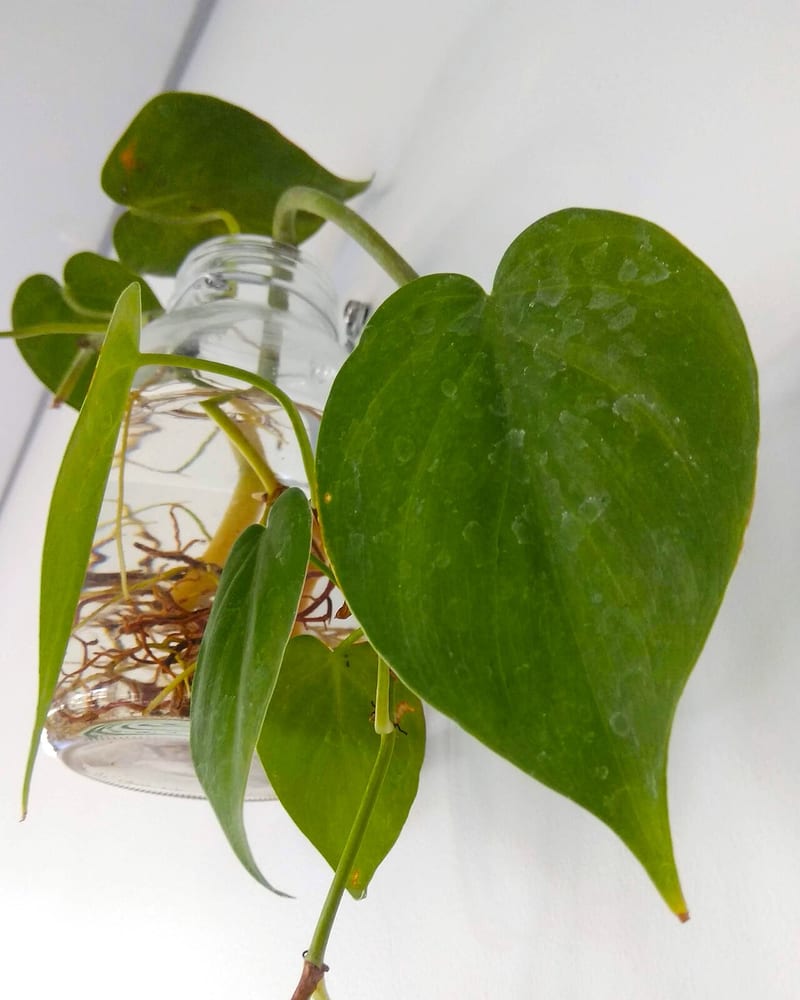
Quick care specs.
| Parameter | Value |
|---|---|
| Watering | Every 8 days (summer), 13 days (winter) |
| Light | Bright indirect; tolerates medium with longer internodes |
| Lux range | 500–1500 |
| Humidity | 40-60% — happy in average home air |
| Temperature | 18-27°C; suffers below 13°C |
| Toxicity | Toxic to cats and dogs (calcium oxalate) |
| Difficulty | easy |
Watering guide.
Philodendron hederaceum forgives neglect far more than over-watering. In a 6-inch plastic pot with medium-bright light, 7-10 days between waterings keeps it glossy without soaking the roots. Let the top 3-4 cm dry before the next pour. Terracotta pulls that down to 5-7 days; an oversized pot stretches it to 12+ days.
The common failure mode is a waterlogged pot without drainage holes — the roots rot quietly and the first visible sign is sudden yellow leaves near the base. Always use a pot with drainage. The watering schedule generator can factor in your pot material and light level.
Light requirements.
Target 500-1500 lux — bright indirect from an east-facing window or 1-2 m back from a south-facing one. Below 300 lux the vine still grows but stretches; you will see internodes (the gap between leaves) lengthen from 5 cm to 12+ cm, and leaves shrink. That legginess is reversible by moving closer to light.
Harsh midday sun through a clear window bleaches leaves within a week. A sheer curtain fixes it. To sanity-check your spot, the light requirement matcher cross-references lux with plant preference.
Common problems.
| Symptom | Cause | Fix |
|---|---|---|
| Long gaps between leaves, small leaves | Not enough light | Move to brighter spot; trim leggy stems and root the cuttings |
| Yellow leaves near the base | Over-watering or soggy soil | Reduce frequency; verify drainage hole is clear |
| Brown leaf tips | Low humidity below 35% or salt buildup | Flush soil with distilled water; group with other plants |
| Leaves curling inward | Under-watered or root-bound | Soak-water, then check if roots circle the pot |
| Brown spots on leaves | Cold water or bacterial spot | Use room-temperature water; remove affected leaves, avoid misting |
| No new growth for months | Dormant season or starved | Fertilise at half strength every 4 weeks in spring-summer only |
Propagation.
Cut a 10-15 cm stem section with at least 2-3 leaves, making the cut just below a node (the bump where aerial roots emerge). Drop it in a jar of water with the node submerged and the top leaves above. Roots appear in 7-10 days at room temperature. Pot up in soil once roots reach 3-5 cm.
You can skip the water step and plant cuttings directly into moist potting mix — success rate is about 85% in my experience versus 98% for water propagation, per my own log of 40+ cuttings.
FAQ.
Philodendron or pothos — how do I tell?
Philodendron leaves are thinner, matte, and heart-shaped with a pointed tip. Pothos leaves are thicker, waxy, and often variegated with yellow or white streaks. Pothos also has a more rigid petiole.
Is it safe around cats?
No. AVMA lists all Philodendron species as toxic due to calcium oxalate. Chewing causes mouth irritation and drooling. Hang it high or choose spider plant if cats roam free.
Why are my cuttings rotting in water?
Change the water every 3-4 days, keep the jar in indirect light (not full sun), and make sure only the node and stem are submerged — not the leaves. A clear glass jar helps you spot cloudy water early.
Can I grow it without a trellis?
Yes, but trailing philodendron on a shelf produces smaller leaves than climbing on a moss pole. Leaves grow 2-3x larger when the vine has something to grip.