Pothos — Epipremnum aureum
Pothos is the plant people keep when they say they can't keep plants. It tolerates dim light, irregular watering, and poor soil. Cuttings root in water in under three weeks. The only real killer is chronic over-watering.
Quick care specs.
| Parameter | Value |
|---|---|
| Watering | Every 9 days (summer), 14 days (winter) |
| Light | Low to bright indirect — extremely tolerant |
| Lux range | 400–1500 |
| Humidity | 40–50% is fine; tolerates 25% |
| Temperature | 18–29°C; stops growing below 10°C |
| Toxicity | Toxic — calcium oxalate causes oral irritation |
| Difficulty | easy |
Watering guide.
Water when the top 2–3 cm of soil is dry — or when the leaves start to droop slightly. Pothos is one of the few houseplants where visible drooping is a reliable watering cue; the leaves perk up within 2–3 hours of a good soak. In a 15 cm pot this is typically 7–10 days in summer, 10–14 in winter, and up to 18 days if placed in low light.
Over-watering is the only common way to kill pothos. Yellow leaves and black stems near the soil mean root rot — repot in fresh dry mix and cut away any mushy roots. Under-watering is nearly always recoverable: a crispy, dehydrated pothos will usually put out new leaves within two weeks of being watered. See the watering schedule generator for intervals by pot and light.
Light requirements.
Pothos tolerates 200–2000 lux. At the low end (a north-facing room or 3+ metres from a window) growth slows and variegation fades. At the high end (bright east window, 1–2 metres away) it grows aggressively — up to 30 cm of vine per month in summer. Avoid direct afternoon sun through glass; leaves bleach quickly.
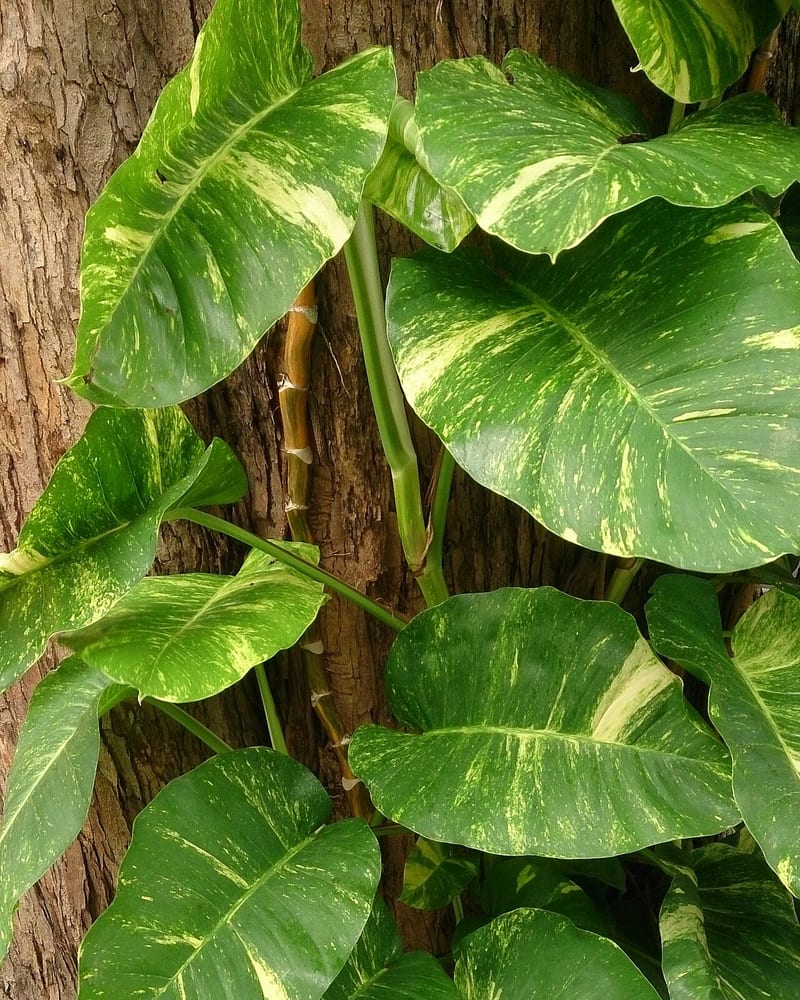
Variegated cultivars (Marble Queen, N'Joy, Manjula) need more light to keep their white or cream patterns; in low light they revert to solid green. The light requirement matcher helps you check whether your spot hits the 800–1500 lux sweet spot.
Common problems.
| Symptom | Cause | Fix |
|---|---|---|
| Yellow leaves | Over-watering | Let soil dry fully; check for root rot |
| Leggy vines with few leaves | Too little light | Move closer to window; prune to encourage bushiness |
| Variegation fading | Insufficient light | Provide 1000+ lux for 6 hours daily |
| Brown leaf tips | Dry air or fluoride in tap water | Use filtered water; flush soil monthly |
| Drooping leaves | Under-watering (usually recoverable) | Water thoroughly; perks up in 2–3 hours |
| Black mushy stems at soil line | Root rot from chronic over-watering | Take cuttings from healthy vines; compost the parent |
Propagation.
Pothos is the easiest mainstream houseplant to propagate. Cut any vine below a node (the small brown bump where aerial roots form), drop the cutting into a glass of water, and wait. Roots appear in 7–14 days; the cutting is ready for soil at 2–3 weeks when roots are 5 cm long. Success rate approaches 100% as long as the cutting has at least one node.
A single long vine can be cut into 5–10 single-node pieces, each of which roots independently. Planting 4–6 rooted cuttings into one pot gives a full, bushy plant in 2–3 months — much faster than waiting for a single plant to bush out.
FAQ.
Is pothos safe for cats?
No. All parts contain calcium oxalate crystals. Chewing causes oral burning, drooling, and vomiting. It's rarely fatal but unpleasant — hang it high or choose a pet-safe alternative like spider plant.
Why is my variegated pothos turning all green?
Variegation requires light. In rooms under 500 lux, variegated cultivars revert to solid green because the plant prioritises chlorophyll. Move it closer to a window and new leaves should show variegation again.
How long do pothos cuttings need before planting in soil?
Wait until roots are 5 cm long, typically 2–3 weeks after cutting. Planting earlier works but increases transplant shock. Cuttings can also live in water indefinitely if you change the water every 2 weeks.
Can I train pothos up a wall or moss pole?
Yes. Pothos is a natural climber and leaves grow larger when it has support. Secure vines to a pole or wall with soft plant ties every 20–30 cm. Expect leaves up to 15 cm across after a year of climbing.