Spider plant — Chlorophytum comosum
Spider plants are the only common houseplant that sends out entire baby clones on long stolons. Leave them dangling and you will have a dozen plantlets inside a year. The only real failure mode is chronic over-watering in a no-drainage pot.
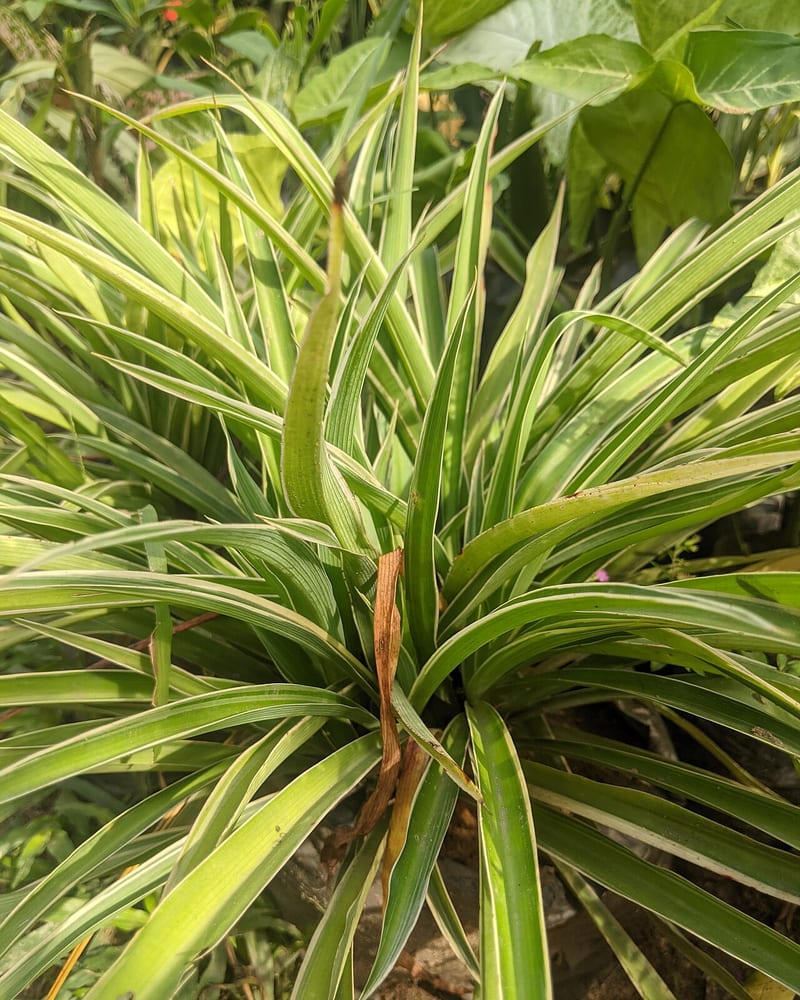
Quick care specs.
| Parameter | Value |
|---|---|
| Watering | Every 8 days (summer), 13 days (winter) |
| Light | Bright indirect to bright; tolerates medium with slower growth |
| Lux range | 800–2000 |
| Humidity | Any — thrives in dry or humid rooms |
| Temperature | 15-24°C; tolerates brief dips to 10°C |
| Toxicity | Non-toxic, pet-safe (AVMA confirmed) |
| Difficulty | easy |
Watering guide.
Spider plants store water in their tuberous white roots, which doubles as a moisture buffer. In a 15 cm plastic pot with bright indirect light, 8-9 days between waterings is typical. Let the top 3 cm dry before the next watering — these roots suffocate quickly in constant wet soil. Winter stretches to 10-13 days.
A visual tell: when soil is fully dry, the leaves angle outward and slightly pale. Fresh watering restores upright posture within a few hours. The watering schedule generator can set an interval matched to your pot and light.
Light requirements.
Variegated forms (the white-striped green ones you see everywhere) need 1000+ lux to keep their stripes sharp. Below 500 lux, the variegation fades and leaves revert toward solid green. Solid-green cultivars are more forgiving and happy in medium light around 600 lux.
Direct midday sun scorches the thin leaves; bright indirect from an east window or a sheer-curtained south window is the sweet spot. Use the light requirement matcher to confirm a suitable spot.
Common problems.
| Symptom | Cause | Fix |
|---|---|---|
| Brown leaf tips | Fluoride, chlorine, or salt buildup in tap water | Switch to filtered or rainwater; flush soil quarterly |
| Pale, faded stripes on variegated forms | Not enough light | Move to brighter indirect spot (1000+ lux) |
| Mushy, yellow leaves | Over-watering, no drainage | Pot with drainage holes; dry out for 10-14 days |
| No pups even after a year | Plant too young or pot too large | Pups appear when root-bound; leave it slightly tight in its pot |
| Crispy leaf edges (all of them) | Extreme dryness or full sun exposure | Water deeply; relocate from direct sun |
| Black leaf bases | Crown rot from water sitting in the crown | Water at soil level only; remove affected leaves |
Propagation.
Spider plants propagate via plantlets (pups) on long flowering stems. Once a pup has 3-4 small leaves and visible root nubs underneath, cut it from the stolon and either plant directly in soil or root in a shallow dish of water for 7-10 days. Success rate is near 100% — the easiest propagation of any common houseplant.
To force pup production, keep the plant slightly root-bound and give it 12+ hours of indirect light. Healthy mature plants push 4-10 pups per growing season.
FAQ.
Is spider plant really safe for cats?
Yes — AVMA and ASPCA both list Chlorophytum comosum as non-toxic. Some cats are drawn to chew the leaves (mild hallucinogenic effect similar to catnip). Excessive chewing can cause mild stomach upset but no real danger.
Why are the tips always brown on mine?
Municipal tap water in most cities contains fluoride, which spider plants accumulate in leaf tips until they scorch. Collect rainwater or use distilled water — the next 6 months of new growth will be clean-tipped.
Should I cut off the pups?
Only if you want to propagate. Leaving them attached does not harm the parent, and a plant dangling with pups looks sculptural in a hanging basket.
Why are the leaves splitting lengthwise?
Usually mechanical damage from brushing past a narrow spot, or occasionally sudden temperature drop. Trim the damaged leaf at the base — a new one grows from the crown within a month.